See Table Of Contents (Here)
Time of Israel writes about how spiritually unfulfilling the Noahide lifestyle is.
https://www.timesofisrael.com/what-do-the-third-temple-movement-and-noahide-laws-have-in-common-a-far-right-vision/
What do the Third Temple movement and Noahide laws have in common? A far-right vision
In her new book ‘Messianic Zionism in the Digital Age,’ Rachel Z. Feldman documents a growing fringe movement to hasten the messiah’s coming – and its incendiary geopolitical implications
By Rich Tenorio Follow
20 September 2025
When Israel’s National Security Minister Itamar Ben Gvir delivered a provocative speech on August 3 calling for not just the destruction of Hamas, but the occupation of the Gaza Strip and the voluntary emigration of Palestinians from the enclave, it wasn’t just what he said that raised eyebrows, but where he said it.
The video, posted on Ben Gvir’s X account on Tisha B’Av, the Jewish day of mourning over the ancient destruction of the First and Second Temples, showed the far-right member of Prime Minister Benjamin Netanyahu’s cabinet standing dressed in a white shirt and dark blazer in front of the Al-Aqsa Mosque in Jerusalem.
The mosque is built on a site venerated by Muslims and Jews alike. Jews know it as the Temple Mount, the site of the two biblical Temples, and where, according to Jewish eschatology, a Third Temple will rise to usher in a messianic era. Muslims call it the Haram al-Sharif, or Noble Sanctuary, and consider it the third-holiest site in Islam, where Muhammad ascended to heaven.
The Temple Mount was captured by Israel in the Six Day War, but in a subsequent deal, control was restored to a Jordanian waqf, or Islamic religious trust.
In a controversial but longstanding arrangement known as the “status quo,” Muslims are allowed by the Waqf to worship at Al-Aqsa; Jews can visit but not pray there.
On Tisha B’Av, Ben Gvir led a group in prayer at the site — an unprecedented act of public worship by a government minister condemned by Jordan as “an unacceptable provocation and a reprehensible escalation.”
While Jewish activists going to the Temple Mount is not a new phenomenon, it’s an increasing one. Many religious nationalists are dismissing geopolitics as well as the traditional Orthodox approach of waiting for the messianic era before setting foot on the holiest of Jewish sites. These activists wish to actively pave the way for the Third Temple by reestablishing a Jewish presence on the Temple Mount.
Outside of Israel, some are using the internet to bring about what they see as another prerequisite for the messianic era: They are helping tens of thousands of non-Jews across the world transition from Christianity to a community called the Children of Noah, Bnei Noah, or Noahides. This community is built on adherence to the Seven Noahide Laws of the Hebrew Bible. It’s debated whether to call Noahidism a religion or not.
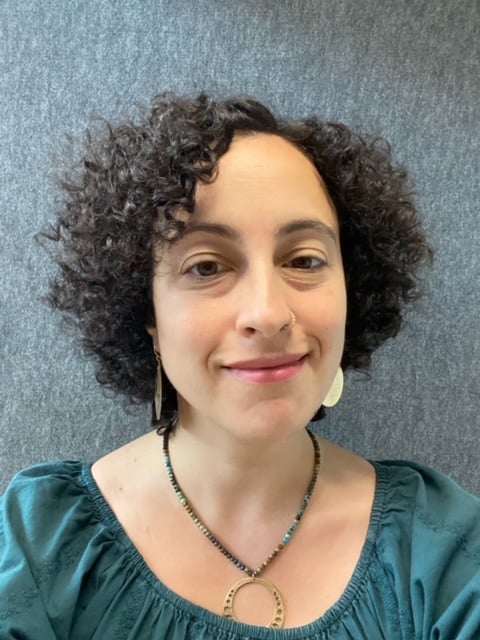
Dartmouth College religious studies professor Rachel Z. Feldman documents these developments in a new book, “Messianic Zionism in the Digital Age: Jews, Noahides, and the Third Temple Imaginary.”

Prof. Rachel Z. Feldman, author of ‘Messianic Zionism in the Digital Age.’ (Courtesy)
“It’s not a book about geopolitics but sight lines on the ground,” Feldman told The Times of Israel. “I tried to enter the daily lives of Temple activists and Noahides, see [things] from their perspective, to understand how their vision of the Third Temple globalized.”
Asked in a follow-up email for comment on Ben Gvir’s visit and prayer on the Temple Mount, she replied: “The status quo has definitely changed. I have watched this play out slowly since I started my research in [2012]. There are Jewish groups praying openly every day now, so what Ben Gvir did is not exceptional in that regard.”
“Regardless,” she added, “I think his act should force us to reflect on how the Temple Mount/Al Aqsa has been used by both Israeli and Palestinian leaders to obtain political goals. The Temple/Al Aqsa is the most potent messianic and political symbol at the heart of the conflict, capable of morally justifying and sacralizing violence.”
A wartime messianic boom
According to the author, Third Temple activism has grown in intensity since the October 7, 2023, Hamas onslaught on Israel and subsequent Israeli war on Hamas in the Gaza Strip. She cites phenomena such as social media memes interweaving the Third Temple and the war, and instances of Israel Defense Forces members spray-painting Third Temple graffiti onto Palestinian homes in Gaza.
“Some Temple activists took a really hard-line militant stance,” she said, “that October 7 was definite proof that Israel should move forward and annex the Temple Mount.”
Feldman wrote the book’s conclusion during the previous conflict between Israel and Hamas in 2021. By that point, she had conducted research in far-flung locations, from Texas to Israel to the Philippines. And she had tracked how Third Temple activism had migrated from the fringe to mainstream Israeli religious nationalism over recent decades.
“We can say that generally, the Orthodox world has a passive messianic approach. You should not physically try to move the messianic era along through practical action,” Feldman said of the mainstream belief that the messiah will only arrive when the Jewish people reach a certain spiritual threshold.
“Where Temple activists diverge,” she said, “goes back to Rabbi [Avraham Isaac] Kook, one of the founding thinkers of religious Zionism: One can take physical acts to manifest the messianic timeline — renew animal sacrifices and the priesthood, bring Jews to the Temple Mount.”
Feldman noted that while Kook did not call for such acts, his present-day followers see them validated by his early 20th-century vision of practical political steps to reestablish a sovereign Jewish nation in the Holy Land.
As for today’s activists’ vision of Israel in the messianic age, she said, it will be “essentially a theocratic state that operates according to Torah law.”
Working from the margins towards the center
One measuring stick of popular acceptance of Temple activism has been the changing location of the Temple Institute, an NGO advocating for a Third Temple.
Founded in 1984 by Rabbi Yisrael Ariel — who was a member of the paratrooper brigade that captured the Temple Mount in the Six Day War — the institute was originally located in a back alley of the Old City of Jerusalem. Today, it occupies a much more prominent space across from the Western Wall. There are other barometers: The formation of a Temple lobby in the Knesset in 2016 and the 50,000 to 60,000 Jews who visit the Temple Mount each year.
As part of her fieldwork, the author went to the Temple Mount with an all-female activist group called Women for the Temple. They were confronted by members of a Palestinian women’s group, the Murabitat, formed to defend the site from Jewish encroachment. The book describes the ensuing scene.
“On the one hand, these [Jewish] activists were going up to have this deep, meaningful, spiritual experience,” Feldman said. “Yet two seconds in, they were surrounded by armed guards and protests from the Muslims.”
The book presents a comprehensive look at the Temple activist movement. Predominantly Ashkenazi and male in leadership, its “foot soldiers” are often female and/or Mizrahim, or Jews of Middle Eastern descent — who have historically faced forms of racism and socioeconomic disadvantages in the nascent Jewish state.
The movement has co-opted the protest language of the left: Activists claim that the Israeli government’s allowing Muslim but not Jewish worship on the Temple Mount is tantamount to apartheid, and they frame their push for Jewish prayer on the site as a civil rights struggle.
“I made it clear I was not an ideological supporter of the Temple movement,” Feldman said. “Some interlocutors tried to convince me. They were not successful.”
Yet, she added, “a sense of respect was established between us. There was a desire on their part not to be seen as crazy, and their internal logic represented, which I took seriously as an anthropologist.”
A Noahide endgame
By that time, Feldman had also found links between Orthodox rabbis in the Temple movement and Noahides across the globe. Rabbis such as the Temple Institute’s Ariel, and Oury Cherki of the Brit Olam World Noahide Center, were reaching out to Noahides — and to Christians interested in becoming Noahides. The Temple Institute found an eager audience in the American Southwest; it was at the institute’s 25th anniversary gala in Dallas in 2012 that Feldman first learned about Noahides from attendees who wore cowboy boots and Stars of David. Meanwhile, Brit Olam created downloadable resources on its website, including a Noahide prayer book and a declaration to uphold the Seven Noahide Laws, which cover issues such as rejection of idolatry, establishing a justice system, and refraining from sexual immorality and theft.
Eventually, Feldman wished to learn about Noahidism from Noahides themselves. She became particularly interested in communities in former Spanish colonies.
“In some places I traveled,” she said, “some rural parts of the Philippines and Mexico, I was the first Jewish person they had ever met in person. They were tuning into Jewish media all day, listening to hours of rabbis on YouTube, maybe even exchanging digital questions with rabbis … But there was no interchange with a Jewish person, in person.”
In the Philippines, Feldman went to a Noahide wedding on the island of Cebu. The bride and groom each referenced the Seven Noahide Laws in their vows. Feldman was a welcome guest, enjoying mangoes, pineapple and coconuts while getting asked by multiple congregation members to bless them.
“Many Noahides in [former] Spanish and Portuguese colonies … share similar life histories,” Feldman said. “They were born into Catholic families. As they grew up, they started questioning the divinity of the church and moved to Protestantism.
“Within Protestantism, they started to explore more and more Hebrew Roots Christianity, which emphasizes the Hebrew Bible. The closer they started to read the Hebrew Bible, the more they got into Judaism — which led them to question the divinity of Jesus.”
For many, this path led not to a Jewish conversion, but to Noahidism — which, Feldman explained, was due to geographical, financial and logistical reasons.
She noted that many would-be converts in the Philippines sought an Orthodox conversion, but faced barriers. For example, an Orthodox community in Manila that welcomes converts is located in an expensive neighborhood, making it hard for villagers from other islands to relocate.
Becoming a Noahide can bring complications of its own.
“After rejecting Jesus, they’re in a kind of no man’s land in terms of religious identity,” Feldman said. “Becoming Noahide gives them a status under Jewish law… The problem for them is that most people are not satisfied with just having a legal status as a religious identity.”
“From an Orthodox rabbinic perspective, Noahidism is a legal status, defining who is a God-fearing and non-idolatrous gentile, not a religion,” she added. “Some [Noahides] are content with that… The majority of people I interviewed in the Philippines and in Latin America are yearning for something more.”
In the book’s conclusion, Feldman contemplates what that “something more” could mean.
“Even as digital channels extend forms of rabbinic authority to new locales,” she writes, “the Noahide faith might eventually upend barriers to Jewish conversion in the Global South as Noahides speak back to rabbinic centers of power and exert their own influence on the Orthodox Jewish world.”
As for the Third Temple, Feldman raises provocative questions in the final pages, inspired by the 18th-century kabbalist, Rabbi Nachman of Breslov.
“What might an alternative political theology of the Third Temple look like?” she asks. “Could ancient Jewish notions of the entire world as a ‘Third Temple’ motivate a radical ecological ethics or a greater concern for global wealth disparities? Maybe the Third Temple is already nascent inside of us, in our untapped abilities to build a truly sustainable and equitable planetary Temple home.”
.jpg)